
If you manage, supervise, or are training to become a Registered Behavior Technician (RBT), the RBT Competency Assessment is one of the most important checkpoints you’ll face. It’s the practical, hands-on evaluation that proves a technician can actually deliver applied behavior analysis (ABA) services safely and correctly – not just answer questions about them on an exam.
In this guide, we’ll break down exactly what the RBT Competency Assessment covers in 2026, who is allowed to administer it, how it’s scored, and how initial and renewal assessments differ. You’ll also get a preparation checklist for candidates and supervisors. Everything here is based on the current requirements from the Behavior Analyst Certification Board (BACB).
In this guide
- What is the RBT Competency Assessment?
- RBT Competency Assessment vs. the RBT exam
- What changed for 2026
- Who can administer it
- The three assessment methods
- The full task list (2026)
- How it’s scored
- What if a task isn’t demonstrated?
- Initial vs. renewal
- The renewal assessment, step by step
- The certification process, step by step
- Preparation checklist
- For supervisors: running a smooth assessment
- Common mistakes to avoid
- FAQ
What is the RBT Competency Assessment?
The RBT Competency Assessment is a standardized, performance-based evaluation required by the BACB. In short, it confirms that a technician can demonstrate the core skills of the RBT role in real practice, rather than simply describe them.
Because it is skills-based, the assessment focuses on three underlying themes:
- Safety – running procedures without putting the client or others at risk.
- Technical accuracy – measuring behavior, running teaching procedures, and collecting data correctly.
- Professionalism and ethics – protecting client dignity, maintaining boundaries, and working within the RBT scope of practice.
Overall, there are two versions you’ll hear about: the RBT Initial Competency Assessment (completed once, before you apply for certification) and the RBT Renewal Competency Assessment (part of staying certified). We’ll cover both below.
RBT Competency Assessment vs. the RBT exam
People often confuse these two steps, but they test very different things. The RBT Competency Assessment is a hands-on check of what you can do; the RBT exam is a multiple-choice test of what you know. In other words, the assessment proves you can perform the skills, while the exam proves you understand the concepts behind them. Importantly, you complete the competency assessment first, and only then do you sit for the exam.
| RBT Competency Assessment | RBT Exam | |
| Format | Hands-on demonstration, observed by an assessor | Multiple-choice, at a testing center |
| Tests | Skills (can you do it?) | Knowledge (do you understand it?) |
| When | After the 40-hour training, before you apply | After your application is approved |
| Who runs it | A qualified assessor at your organization | Pearson VUE (BACB’s testing vendor) |
What changed in the RBT Competency Assessment for 2026
The BACB updated the assessment with a document effective date of January 1, 2026. The headline change most people notice is this: the assessment now contains 19 tasks (down from the previous 20), reorganized into five clear categories. In addition, the update sharpens the emphasis on hands-on demonstration with real clients, data accuracy, and ethical conduct.
Because the BACB revises these requirements periodically, always work from the current documents before you administer or complete an assessment. Specifically, keep the 2026 RBT Initial Competency Assessment packet and the RBT Handbook handy.
Who can administer the RBT Competency Assessment?
Not just anyone can sign off on an assessment. The BACB defines specific roles, and getting this wrong is one of the most common reasons an application gets delayed.
The Responsible Assessor
The Responsible Assessor owns the quality of the assessment and signs the final attestation. This person must:
- Hold an active BCBA or BCaBA certification.
- Have completed the required 8-hour supervision training.
- Be employed by, or under contract with, the applicant’s organization.
- Not be related to, subordinate to, or employed by the applicant.
Assistant Assessors
In addition, some or all of the observation can be delegated to an Assistant Assessor, who must:
- Hold an active RBT certification or higher.
- Demonstrate their own proficiency in the tasks they observe.
- Not be related to or employed by the applicant.
In practice, a BCBA typically serves as the Responsible Assessor, while an experienced RBT or BCaBA helps observe individual tasks. Even so, the Responsible Assessor still verifies quality and signs off.
The three assessment methods
Each task is evaluated using one of three approved methods. Knowing these ahead of time removes a lot of test-day anxiety.
- With a client – The assessor directly observes the candidate performing the task with an actual client who is receiving services.
- Role-play – The candidate performs the task with another person acting as the client. This is common for procedures that are unsafe or impractical to stage on demand, such as crisis or emergency procedures.
- Interview – In a live interview (in person or over the internet), the candidate describes a concept and gives a concrete example.
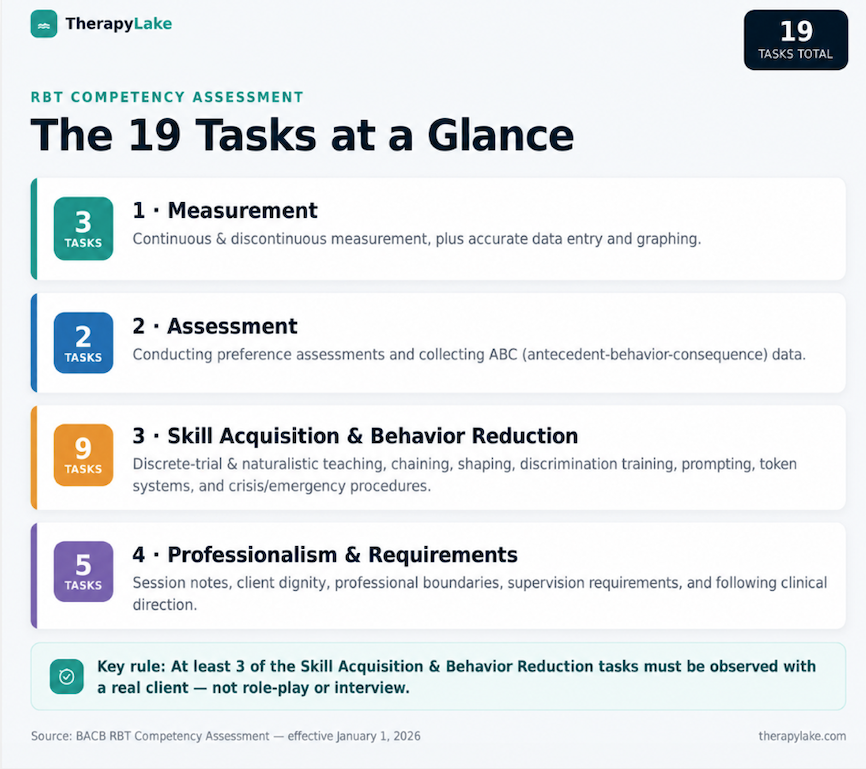
However, there’s one rule you can’t work around: at least three of the Skill Acquisition & Behavior Reduction tasks (tasks 6–14) must be conducted with a real client – not role-play or interview. Therefore, plan the assessment so a genuine client session is available for those tasks.
The full RBT Competency Assessment task list (2026)
The 19 tasks are grouped into five categories. Below is the structure, with plain-English notes on what each area is really checking. For the official wording, see the BACB RBT Task List / test content outline.
| Category | Tasks | What it checks |
| 1. Measurement | 3 tasks | Running continuous and discontinuous measurement, plus entering or graphing data accurately. |
| 2. Assessment | 2 tasks | Conducting preference assessments and collecting ABC (antecedent-behavior-consequence) data. |
| 3. Skill Acquisition & Behavior Reduction | 9 tasks | Discrete-trial teaching, naturalistic teaching, chaining, shaping, discrimination training, prompting, token systems, crisis/emergency procedures, and one task drawn from antecedent interventions, differential reinforcement, or extinction. |
| 4. Professionalism & Requirements | 5 tasks | Writing session notes, protecting client dignity, maintaining professional boundaries, meeting supervision requirements, and following clinical direction. |
Notice how weighted the assessment is toward teaching procedures and behavior reduction – nearly half of all tasks. As a result, that’s where most candidates should concentrate their practice.
How the RBT Competency Assessment is scored
Scoring is deliberately simple and binary. For each task, the assessor marks either:
- Demonstrated – the candidate performed the task correctly and completely, or
- Not Demonstrated – the candidate did not.
There is no partial credit. A task is either done to standard or it isn’t. On the upside, the assessment can be spread across multiple sessions, so a task can be re-taught and re-observed later. In other words, candidates don’t need to nail all 19 tasks in a single sitting.
What happens if a task isn’t demonstrated?
First, don’t panic – a “Not Demonstrated” mark is not a failed exam. Because the RBT Competency Assessment can be split across multiple sessions, your assessor can simply re-teach the skill and observe it again later. There’s no fixed waiting period or retake fee for the assessment itself; instead, you keep working until every task is demonstrated. Consequently, most candidates who prepare well finish without ever needing to restart. The key is to treat each “Not Demonstrated” as feedback, practice that specific skill, and schedule a quick re-observation while it’s still fresh.
Initial vs. renewal: what’s the difference?
The initial and renewal assessments serve different purposes. The initial version confirms a new technician is ready to practice, whereas the renewal version verifies that an experienced RBT is still performing to standard.
| Aspect | Initial Competency Assessment | Renewal Competency Assessment |
| When | Once, before you apply for certification | As part of maintaining certification (typically annually, before your expiration date) |
| Purpose | Confirm entry-level readiness | Verify continued, real-world competence |
| Timing rule | After the 40-hour training; no more than 90 days before you apply | Completed within the window before your certification expires |
| Who administers | Qualified Responsible Assessor (BCBA/BCaBA) + optional assistants | A BACB-approved supervisor (BCBA, BCaBA, or approved RBT supervisor) |
The RBT Renewal Competency Assessment, step by step
Renewal tends to worry people less than the initial assessment, but it still needs a plan. Here’s how the renewal process generally works:
- Track your expiration date – Certification is maintained on a cycle, so mark when yours is due well in advance.
- Line up a qualified supervisor – A BCBA, BCaBA, or approved RBT supervisor conducts the renewal competency assessment.
- Demonstrate the skills again – The renewal covers the same task areas as the initial assessment, but the focus shifts toward real-world, on-the-job performance.
- Get the attestation signed and keep the documentation on file.
- Complete the rest of your renewal – For example, meeting supervision and ethics requirements – and submit before your deadline.
Please note: the BACB has been actively revising RBT renewal and continuing-requirement rules, and details can change from year to year. Therefore, before you rely on any renewal timeline, confirm the current requirements in your BACB account and the latest RBT Handbook.
The initial certification process, step by step
Here’s where the competency assessment fits within the larger path to becoming an RBT:
- Complete the 40-hour training based on the RBT Task List.
- Pass a background check as required.
- Complete the RBT Initial Competency Assessment with a qualified assessor – again, this can happen across multiple sessions.
- Submit your certification application (the assessment must be completed no more than 90 days before you apply).
- Schedule and pass the RBT exam.
Because the competency assessment sits right in the middle of this sequence, a disorganized assessment is one of the most common causes of delayed certification. Fortunately, building a clean, repeatable process pays off – more on that below.
How to prepare for the RBT Competency Assessment: a checklist
Use this as a study guide and pre-assessment checklist. In our experience, candidates who walk in able to show, not just explain, each item are the ones who pass on the first attempt.
- Know your measurement cold – Be ready to run frequency, duration, and interval recording, and to enter and graph data without hesitation.
- Practice preference assessments and ABC data collection with real materials, not just on paper.
- Rehearse each teaching procedure – discrete-trial, naturalistic teaching, chaining, shaping, discrimination training, and prompting – until the steps are automatic.
- Drill crisis and emergency procedures in role-play so you stay calm and correct under pressure.
- Write a clean session note that captures what happened, the data, and the client’s response – concise and objective.
- Memorize the RBT scope of practice, and be ready to describe how you protect client dignity and maintain boundaries with specific examples.
- Prepare a real client session for the three tasks that must be observed with an actual client.
- Review the current RBT Task List so your language matches the terminology your assessor uses.
For supervisors: how to run a smooth, defensible assessment
Most guides speak only to candidates. However, the assessor carries just as much responsibility – and a messy process creates compliance risk while slowing down onboarding for the whole clinic. If you’re a BCBA or clinic owner, these practices keep assessments consistent and audit-ready:
- Standardize your assessment form so every technician is evaluated against the same 19 tasks with the same criteria.
- Schedule around real client sessions in advance, so the three required client-observed tasks aren’t left to chance.
- Log which method was used (client, role-play, or interview) for each task, and keep the signed assessment on file.
- Track supervision hours and contacts alongside the assessment, since supervision requirements run in parallel with certification.
- Re-observe “Not Demonstrated” tasks quickly, while the teaching is still fresh, rather than restarting the whole assessment.
This is where the right systems make a real difference. For example, clinics that run onboarding, data collection, and scheduling and supervision tracking in one place spend far less time chasing paperwork and far more time developing their technicians. TherapyLake was built for exactly this kind of ABA workflow, keeping assessments, supervision, and session data organized so nothing slips between onboarding and certification.
Common RBT Competency Assessment mistakes (and how to avoid them)
- Delaying reinforcement – Even a small lag during teaching can read as “Not Demonstrated,” so practice tight, immediate delivery.
- Vague instructions – Give clear, concise directions to the client, because rambling prompts undermine the procedure.
- Stepping outside RBT scope – Don’t modify a program or make clinical decisions during the assessment; instead, follow the behavior plan as written.
- Sloppy or subjective session notes – Stick to objective, measurable language.
- Choosing the wrong assessor – Confirm the Responsible Assessor meets every BACB requirement before the assessment, not after.
- Skipping the real-client requirement – Remember that three Skill Acquisition & Behavior Reduction tasks can’t be role-played or interviewed away.
Sample interview-style prompts to practice
For interview-method tasks, you’ll be asked to describe a concept and give an example. To prepare, rehearse crisp, example-driven answers like these:
- “Explain the difference between continuous and discontinuous measurement, and give an example of when you’d choose each.”
- “Describe how you would maintain a client’s dignity during a difficult session. Give a specific example.”
- “Walk me through how you’d collect ABC data for a target behavior, and what you’d record.”
- “A supervisor asks you to do something outside the RBT scope of practice. What do you do?”
Strong answers are short, concrete, and always include a real example. In fact, if you can teach the concept to a colleague, you can pass the interview items. New to some of these terms? Our ABA glossary has plain-English definitions.
RBT Competency Assessment FAQ
What is the RBT Competency Assessment?
It’s a standardized, performance-based evaluation required by the BACB that confirms a Registered Behavior Technician can safely and correctly demonstrate core ABA skills. It’s separate from the written RBT exam: the exam tests knowledge, while the assessment tests hands-on ability.
How many tasks are on the RBT Competency Assessment in 2026?
There are 19 tasks, organized into five categories: Measurement, Assessment, Skill Acquisition & Behavior Reduction, and Professionalism & Requirements. The version effective January 1, 2026 reduced the total from 20 to 19 tasks.
Who can administer the RBT Competency Assessment?
A qualified Responsible Assessor – an active BCBA or BCaBA who has completed the 8-hour supervision training and is connected to the applicant’s organization, but not related to or supervised by the applicant. Assistant Assessors who hold RBT certification or higher can help observe individual tasks.
How is the RBT Competency Assessment scored?
Each task is marked “Demonstrated” or “Not Demonstrated.” There is no partial credit, but the assessment can be completed over multiple sessions, so tasks that aren’t demonstrated can be re-taught and re-observed.
How long does the assessment take?
It varies. Because it can be spread across multiple sessions and depends on client availability and the candidate’s readiness, it may take anywhere from a couple of hours to several shorter sessions.
Do I have to renew the competency assessment every year?
RBT certification must be maintained on an ongoing basis, and a renewal competency assessment has traditionally been part of that process. Because the BACB updates these requirements periodically, confirm the current renewal steps and timeline in your BACB account before your certification expiration date.
Final thoughts
The RBT Competency Assessment isn’t meant to trip technicians up. Rather, it’s a structured way to confirm they can deliver ABA services safely, accurately, and ethically. Candidates who practice demonstrating each of the 19 tasks tend to pass on the first try, and clinics with a standardized, well-documented process get their new RBTs certified faster and with less compliance risk.
If you’re building or tightening that process, keeping onboarding, supervision, and data in one organized system removes most of the friction. See how TherapyLake helps ABA clinics streamline technician onboarding and supervision →
This article is for general informational purposes and reflects publicly available BACB requirements at the time of writing. Always verify the current RBT Competency Assessment requirements at bacb.com before administering or completing an assessment.